Leon Anawak
The SwarmLeon Anawak is a marine-mammal scientist whose expertise makes him a key investigator of the attacks on whales and ships, but his importance extends beyond explaining animal behavior. As the crisis draws him from Vancouver Island to Nunavut and ultimately into the dangerous work aboard the USS Independence, his career becomes entangled with questions of cultural memory, belonging, and how humans recognize intelligence unlike their own. He begins as a respected but inward-looking researcher; the widening crisis repeatedly presses him to act, trust others, and reconsider the boundaries between human and nonhuman life.
Background and Scientific Identity
Anawak is thirty-one and has spent four years working at Davie's Whaling Station after completing his doctorate. The station is a crowded, informal workplace, and he originally took the job to support himself while studying. He has since written a groundbreaking book on intelligence and social bonding among marine mammals. His research has earned the respect of experts and established his reputation as a rising scientific figure, bringing offers of highly paid positions at major institutions. Yet his life on Vancouver Island still has a comfortable, loosely defined quality. He knows that leaving for a lectureship or research fellowship is probably only a matter of time, but the prospect has not yet turned into a decisive departure.
His scientific interest is not limited to classifying animals or recording their movements. The whale attacks force him to ask whether cetaceans can plan, whether they possess a sense of past and future, and what could lead them to ram or sink a tug. Those questions are grounded in his knowledge that dolphins and belugas recognize themselves in mirrors, but he does not treat that capacity as a simple proof of human-like thought. He wonders instead whether their motives and forms of planning can be understood at all through human categories. That caution becomes important as the evidence grows stranger: observable behavior gives investigators a problem to explain, not an immediate answer about the minds behind it.
Investigating the Whale Attacks
When the Canadian authorities organize a scientific response, John Ford makes Anawak an adviser to the operations centered at Vancouver Aquarium. Ford considers him one of the few people capable of interpreting what might be happening inside a whale's mind. Anawak joins the investigation at a moment when the ordinary frameworks for emergency response offer little guidance: the central uncertainty is whether whales have gone mad or whether some outside influence is affecting them. At one briefing, he is nominated as spokesman, a public role that contrasts with the solitary concentration of his research.
A useful distinction emerges from the records: the attacks involve transient orcas, while resident orcas have not been identified among the attackers. Anawak's response to that pattern is to think experimentally. Awake at night in his Vancouver apartment, he considers tagging a whale with a transmitter and camera, hoping that tracking an animal still involved in the attacks might reveal what the research team cannot observe from outside. The idea depends on getting close enough to fit a device without changing the behavior under study. He later explains to Danny how the tag works: a crossbow launches a dart whose tip penetrates the whale's blubber, carrying a time-depth recorder for several weeks. The method, developed by a biologist in Kiel, offers a way to follow an animal through a world with few visual reference points and little human access.
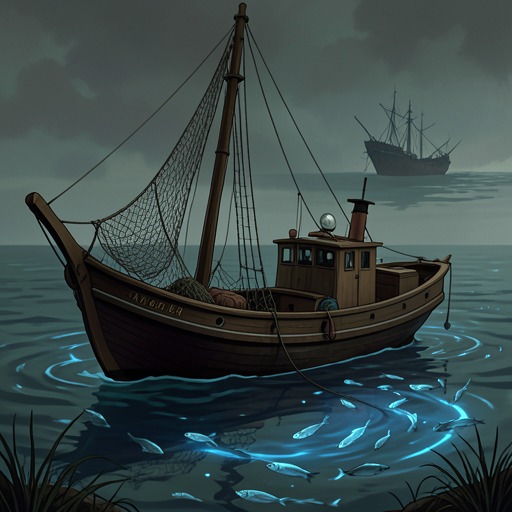
Anawak's investigation also develops through repeated scrutiny of evidence rather than confidence in an early explanation. He and Ford spend forty-eight hours reviewing a sequence that begins in darkness, includes three signals outside the human hearing range, and then shows a blue-tinged luminous cloud spreading across the screen. Whales appear as large silhouettes in front of it. A biologist from Nanaimo who specializes in bioluminescence supports their conclusion that both the cloud and the flashes are organic. The expert can suggest that the flashes result from a chain reaction, but cannot establish what triggers them or what purpose they serve. Their shape recalls squid, yet a creature large enough to account for the image would be extraordinary, and a giant squid would not explain the cloud or the origin of the flashes. Anawak and Ford therefore report what the evidence supports without pretending it solves the mystery.
He is also alert to the danger of mistaking a visible symptom for the whole crisis. After the plane crash, Alicia Delaware searches for reports of whale attacks elsewhere. Anawak connects that search with the possibility that whales may be only the part of a wider problem that humans can see. His attention shifts among animal behavior, biological evidence, and the gaps in what authorities disclose. When Sue Oliviera asks to examine more mussels, the request adds another line of investigation to a case that cannot be confined to whales alone. Anawak's work thus becomes a search for connections among anomalies, rather than an attempt to make every disturbing event fit a single familiar explanation.
Cultural Memory and Return to Nunavut
Anawak's scientific life is accompanied by a more personal estrangement. He left his northern homeland nineteen years before returning to Nunavut, and the reunion with Ijitsoq Akesuk reveals how much time and silence lie between them. Akesuk, whom Anawak initially has difficulty recognizing after the years apart, greets him with an embrace and a stream of Inuktitut. The welcome is especially resonant in a culture where there are many words for greeting and none for farewell: no one had said goodbye when Anawak left, not even the old man who remained at the airfield. The return does not erase the separation, but it makes the relationship present again.
Anawak's reunion takes place against a history of disruption to Inuit life. The narrative describes the effects of the Indian Act of 1885 on Indigenous oral tradition and identity, including pressure to leave ancestral homelands and send children to residential schools. It also recounts the forced relocation of Inuit families to Resolute Bay and Grise Fjord during the Cold War, under a policy described by officials as relocation, and the imposition of numbered dog tags. Earlier changes had included the arrival of white trappers with guns, severe declines in seal and caribou populations, disease, settlement, poverty, and the establishment of secret radar stations on traditional hunting grounds. These details place Anawak's separation from home within a wider history of cultural and political change, without reducing his own return to a simple act of recovery.
Akesuk also describes a community adapting rather than standing outside history. Inuit people are governed by Inuit in a civil state; traditions such as dog-sled travel, igloo building, and making fire with flints are being revived, even as older forms of nomadic life and social organization have changed. The Internet offers a different kind of roaming through networks of information. Anawak listens to this account and, impulsively, tells Akesuk what the scientific team has been discussing: their work and their suspicion that intelligent beings live in the sea. He knows he is breaking Judith Li's instructions, but chooses to confide in the family member he has left. The disclosure marks a change in his conduct: rather than maintaining silence and professional isolation, he risks disobedience in order to restore trust with someone connected to his past.
The encounter also sharpens the ecological ideas surrounding his work. A teaching described as central to Indigenous cultures holds that a change in one part of the world affects the rest: river, people, animals, and sea are not separate systems. Anawak's return makes this principle more than an abstract parallel to ecological research. His scientific case already demands that he look beyond a single species, while his renewed contact with Akesuk places knowledge and relationship within a history of land, community, and disrupted transmission. The two perspectives are not presented as interchangeable, but together they challenge the assumption that a problem can be understood by isolating one organism from its surroundings.
Relationships, Conflict, and a Wider Sense of Belonging
Anawak's relations with Jack Greywolf show how the crisis can turn antagonism into obligation without dissolving disagreement. Greywolf and his Seaguards have previously disappeared after disrupting whale-watching operations, leaving tourists angry and Davie Shoemaker to manage the complaints. Anawak is furious at the disturbance and at Greywolf's deliberate ability to provoke one. Yet when Greywolf later saves lives, Anawak goes to see him. He admits that he should have come earlier, acknowledges that Greywolf pulled him from the water, and says that their disagreements about Greywolf's protests and Indigenous beliefs do not outweigh the lives saved. He recognizes that people are calling Greywolf a hero of Tofino and accepts the description. His gratitude does not mean that every dispute has been settled; it means that practical responsibility has become more important than using disagreement as a reason to remain apart.
The risk of such differences becoming obstacles appears again when Anawak questions Greywolf about military marine-mammal research. Anawak cites files from the Space and Naval Warfare Systems Center in San Diego, traces its institutional predecessor at Point Loma, and notes the funding connection to the U.S. Navy Marine Mammal Program. He points out that accounts of marine-mammal training repeatedly raise allegations of dubious experiments, then presses Greywolf about the experiments conducted at Point Loma, where Greywolf had been stationed. The exchange makes Anawak's research serve two purposes: it investigates the whales, and it probes the human institutions that have trained and studied marine mammals. His stated reason for pursuing the line of inquiry is the chance that it might help explain what has happened to the whales.
His relationship to the emergency effort is not always one of willing inclusion. At one point, soldiers who take him into custody do not accept his explanation that he belongs to the committee's scientific arm. They confine him in barracks and question him; he decides there is no point in lying because he will not be allowed to leave. The scene exposes the gap between a scientist's advisory role and the military's control over movement. Later, when he believes he is no longer needed, he responds with anger. Yet his continued work with the team shows that his connection to the crisis is not merely a matter of status. He returns to the evidence and to the practical demands of the mission even when authority and recognition are uncertain.
Anawak is also challenged to reconsider the emotional isolation that has shaped him. He is told that the iceberg he imagined himself floating on was an image of his own retreat: an unapproachable self, not a separate realm into which he had to sink. The sea he enters belongs to the shared human world, with friendship, love, anger, and hostility, and his place is among the living rather than in a preassigned role as a heroic figure. This counsel does not establish that he has suddenly become free of his past. Instead, it gives language to the direction of his change: connection requires entering relationships that include conflict and vulnerability, not seeking refuge in distance.
The Yrr Hypothesis and the Independence Crisis
Aboard the USS Independence, Anawak contributes to a working model of Yrr cognition with Karen Weaver. Their hypothesis uses virtual amoebas equipped with DNA capable of continual mutation and learning. In the model, each cell behaves like an autonomous computer; experience alters its genetic structure, and when cells aggregate, information acquired by one can alter the others. Aggregation would therefore allow knowledge to spread across a collective rather than remain inside a single organism. Anawak presents the idea as biologically questionable but potentially explanatory. It offers a way to imagine cognition that does not depend on a human-style individual mind.
Even so, he resists treating a clever response as decisive proof of consciousness. When the Yrr answer mathematical questions, Anawak points out that this establishes that the questions have been answered, not that the responders possess conscious intelligence in a form humans can recognize. He likewise suggests that the entity under study may not be a single species after all. These qualifications reveal a consistent feature of his scientific judgment: he is willing to entertain radical explanations, but distinguishes an observation from the conclusion people want to draw from it. The distinction matters in a first-contact situation where human beings may confuse intelligence, communication, and consciousness because their own categories are the only ones immediately available.
The research is personal as well as theoretical. Weaver finds Anawak at the computer with the virtual amoebas on screen after a friend has died, and offers sympathy. He continues to work despite the loss, joining Weaver in developing the hypothesis while Sigur Johanson, Mick Rubin, and Sue Oliviera struggle with its biological implications. Later, he helps organize practical tasks aboard the ship, calling for hypodermic syringes and directing others to attend to a submersible. His role moves between conceptual work and immediate action; neither the abstract model nor the physical mission can be separated from the people exposed to danger.
During the final violence aboard the ship, Anawak's previously injured knee remains a problem: he has had trouble with it since the seaplane crash, and Jack Vanderbilt has kicked it. A blast throws Anawak and Samantha Crowe through the ship's hangar and into the water. The scene places him amid the breakdown of the mission's human organization, but it does not leave him passive. He takes the controls of a Zodiac inflatable boat and speeds through the hangar toward an elevator. Earlier, he had noticed his mind being pulled away from the work aboard the Independence and consciously returned his attention to it. The pattern culminates in his continuing to respond to immediate needs amid confusion and danger.
Character Arc and Narrative Significance
Anawak's arc is not a simple conversion from skepticism to belief. He remains a scientist who separates evidence from interpretation, even as the evidence undermines familiar assumptions about species, mind, and communication. What changes more clearly is his willingness to enter relationships and accept responsibilities that cannot be managed from the safety of detached observation. He moves from a solitary career on Vancouver Island into a public advisory role, risks breaking a commander's instructions to speak honestly with Akesuk, acknowledges Greywolf's lifesaving actions despite their conflicts, and participates in a dangerous attempt to understand the Yrr.
The novel also uses Anawak to connect scales of knowledge that are often kept apart. His research begins with the particular behavior of whales and the mechanics of a tracking tag; it expands toward a luminous organic phenomenon, a possible distributed intelligence, and a global crisis. His return to Nunavut places those scientific questions alongside histories of relocation, cultural rupture, and renewed tradition. The ocean that surrounds his work is not a passive backdrop: its changing weather, immense distances, hidden depths, and capacity to move beyond human observation limit what researchers can know and control. Anawak's significance lies in living inside that limit. He neither abandons scientific inquiry nor assumes it can make every unfamiliar form of life legible; instead, he becomes increasingly willing to treat knowledge as a relationship among beings, places, and histories.